PDF Download Brief History of Archaeology: Classical Times to the Twenty-First Century By Brian M. Fagan, Nadia Durrani
When there are many people that don't need to anticipate something more than the advantages to take, we will certainly recommend you to have happy to reach all benefits. Make certain as well as certainly do to take this Brief History Of Archaeology: Classical Times To The Twenty-First Century By Brian M. Fagan, Nadia Durrani that gives the very best reasons to check out. When you really have to get the reason why, this book will most likely make you feel interested.
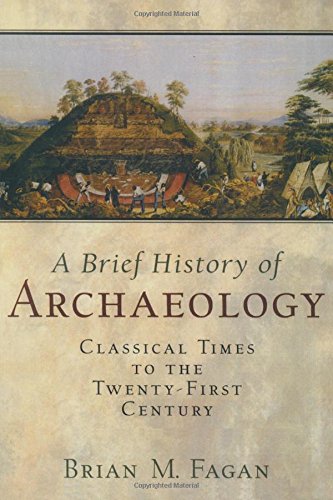
Brief History of Archaeology: Classical Times to the Twenty-First Century By Brian M. Fagan, Nadia Durrani

PDF Download Brief History of Archaeology: Classical Times to the Twenty-First Century By Brian M. Fagan, Nadia Durrani
Let's take a look at the resources that always offer positive points. Impacts can be the factors of just how the people life runs. To get among the resources, you could locate the interesting point to acquire. Just what's that? Book! Yeah, publication is the very best tool that can be utilized for affecting your life. Reserve will not promise you to be wonderful people, yet when you review the book and go through the positive points, you will certainly be an excellent person.
The initial factor of why picking this publication is due to the fact that it's offered in soft file. It suggests that you can wait not just in one gadget but additionally bring it anywhere. Brief History Of Archaeology: Classical Times To The Twenty-First Century By Brian M. Fagan, Nadia Durrani will certainly feature exactly how deep guide will offer for you. It will certainly give you something new. Even this is just a book; the presence will truly demonstrate how you take the inspirations. As well as currently, when you truly have to make handle this book, you can start to get it.
Reviewing will make basic means as well as it's not tight adequate to do. You will certainly have current publication to read really, but if you really feel tired of it you can continuously obtain the Brief History Of Archaeology: Classical Times To The Twenty-First Century By Brian M. Fagan, Nadia Durrani From the Brief History Of Archaeology: Classical Times To The Twenty-First Century By Brian M. Fagan, Nadia Durrani, we will remain to provide you the best book collection. When the book is read in the leisure, you can appreciate how specifically this publication is for. Yeah, while somebody want to get convenience of checking out some publications, you have located it.
Don't worry, the web content is exact same. It ca exactly simplify to read. When you have actually the published one, you have to bring that item as well as load the bag. You may likewise feel so tough to find the printed book in guide store. It will squander your time to opt for strolling forward to the book store as well as browse the book racks by racks. It's one of the benefits to take when selecting the soft documents Brief History Of Archaeology: Classical Times To The Twenty-First Century By Brian M. Fagan, Nadia Durrani as the choice for reading. This could assist you to maximize your complimentary or extra time for everyday.
- Sales Rank: #160078 in Books
- Published on: 2004-03-04
- Original language: English
- Number of items: 1
- Dimensions: 8.90" h x .71" w x 5.98" l, .90 pounds
- Binding: Paperback
- 304 pages
About the Author
Brian Fagan is a leading archaeological writer and internationally recognized authority on world prehistory. He studied archaeology and anthropology at Pembroke College and Cambridge University. He then spent seven years in sub-Saharan Africa working in museums, monument conservation, and excavating early farming sites in Zambia and East Africa. He was a pioneer of multidisciplinary African history in the 1960s. From 1967 to 2003, he was professor of anthropology at the University of California, Santa Barbara, where he specialized in lecturing and writing about archaeology to wide audiences. He is now Emeritus Professor of Anthropology.
Brian Fagan has written six best-selling textbooks (all published by Prentice Hall): Ancient Lives: An Introduction to Archaeology and Prehistory; In the Beginning, Archaeology: A Brief Introduction; World Prehistory; Ancient Civilizations (with Chris Scarre); and this volume–which are used around the world. His general books include The Rape of the Nile, a classic history of Egyptology; The Adventure of Archaeology Time Detectives; Ancient North America; The Little Ice Age; Before California: An Archaeologist Looks at Our Earliest Inhabitants; and The Long Summer. He was also General Editor of the Oxford Companion to Archaeology. In addition, he has published several scholarly monographs on African archaeology and numerous specialized articles in national and international journals. An expert on multimedia teaching, he has received the Society for American Archaeology's first Public Education Award for his indefatigable efforts on behalf of archaeology and education.
Brian Fagan's other interests include bicycling, sailing, kayaking, and good food. He is married and lives in Santa Barbara with his wife and daughter, four cats (who supervise his writing), and last but not least, a minimum of four rabbits.
Excerpt. © Reprinted by permission. All rights reserved.
Lost civilizations, richly adorned royal burials, overgrown cities emerging miraculously from clinging rain forest: Archaeology has a long and romantic history of spectacular discovery. But there is much more to archaeology's history than the finding of palaces and ancient states. I would go so far as to say that you cannot understand today's archaeology without a thorough knowledge of its beginnings, and of the ideas that nurtured it.
Archaeology's achievements have been remarkable. Over the past century and a half, archaeologists have pushed back the story of human origins to a time more than 2.5 million years ago. They have traced the origins of modern humans—ourselves—to tropical Africa more than 150,000 years ago; chronicled the beginnings of agriculture; and reconstructed the minutest details of ancient life. The same 150 years have seen archaeology turn from an amateur pursuit into a sophisticated, multidisciplinary science in the hands of thousands of professional specialists. This history has unfolded against a background of changing intellectual and social environments: from the philosophical speculations of classical writers, and versions of human origins based on the Old Testament, to elaborate theories of multilinear evolution, cultural ecology, and the so-called "postprocessual archaeology" of the 1990s. This book is a brief introduction to the diverse strands of the history of archaeology, both intellectual and nonintellectual. It's a history that melds stories of compelling personalities and eminent archaeologists with accounts of spectacular and not-so-spectacular discoveries, and with ideas about the interpretation of our past.
A Brief History of Archaeology is a journey through the intriguing highways and byways of a discipline that has been a science for less than a century. Books like this are hard to write, because they combine people, discoveries, and ideas in ways that can easily become a confusing melange of information. For this reason, I have chosen to write this book as a simple narrative, passing from archaeologists and their discoveries to changing ideas about the past in as seamless a way as possible.
Chapter 1 traces the beginnings of archaeology to the curiosity of Babylonian monarchs and the philosophical musings of classical writers. We show how theological beliefs limited archaeological inquiry until the nineteenth century, and descibe early antiquarian researches, including the first excavations at the Roman cities of Herculaneum and Pompeii. Chapter 2 discusses the establishment of human antiquity in the mid-nineteenth century, tracing the roots of the ideas that led to the development of archaeology as we know it today. In Chapters 3 to 6, we descibe the beginnings of archaeology in Egypt, Mesopotamia, and Central America. We also discuss the Three Age System for dividing prehistory and the simplistic ideas of linear human progress that dominated nineteenth-century thinking about the prehistoric past. We visit Heinrich Schliemann s excavations at Homeric Troy and descibe the beginnings of biblical archaeology. Chapter 6 ends with the work of Flinders Petrie along the Nile and that of Arthur Evans on the Palace of Knossos on Crete after 1900. Their researches ushered in a new era, which saw a new emphasis on artifacts, dating, and science.
Chapter 7 traces the roots of such efforts in Europe and the Americas, combining a new emphasis on stratigraphic observation and dating with new discoveries in the Andes and Mesoamerica. Chapters 8 to 10 descibe archaeology's coming of age. This was an era of spectacular discoveries like the tomb of Pharaoh Tutankhamun and Ur's royal cemetery, but also of much more sophisticated excavation methods and new ideas for explaining and understanding the remote past. Chapter 10 carries the story into the 1940s and 1950s, with the development of a sophisticated culture history in the Americas and the first efforts at ecological and settlement archaeology, as well as Julian Steward's development of cultural ecology. The story continues in Chapter 11, with the development of radiocarbon dating and increasingly pointed critiques of culture history. We also trace the beginnings of multidisciplinary research, and of salvage archaeology, and the development of world prehistory as a viable intellectual concept in the late 1950s.
Chapters 12 and 13 carry the story from the 1960s through the new millennium, beginning with the intellectual ferment of the 1960s, which saw the birth of the so-called "new archaeology," today called processual archaeology. We assess its significance and its legacy. Chapter 13 surveys the many new theoretical approaches that developed, and are still developing, as a reaction to processualism, as well as other developments such as cultural resource management and the study of an engendered past. Finally, Chapter 14 takes a look at the developing archaeology of the future.
Guides to Further Reading at the end of each chapter provide sources for additional research. A Glossary of Archaeological Sites and Cultural Terms at the end of the book gives additional information on the more important sites mentioned in the text.
This book is not a history of archaeological theory, nor is it a history of archaeology by personality or discovery. It's an attempt to provide a balanced, and, I hope, entertaining account of the history of a relative newcomer to the world of science. As these pages will testify, the discovery of the prehistory of humankind ranks among the greatest scientific achievements of the nineteenth and twentieth centuries. The perspective is international, for I believe that archaeology is a global enterprise, not just a narrowly focused view of the past based on, say, North America, Europe, or the eastern Mediterranean. A Brief History is written in as jargon-free a style as possible and is aimed, in general terms, at readers with no experience of archaeology whatsoever. However, beginners might be advised to acquire a short introduction to archaeological method and theory if they are hazy on the basic principles of the subject.
Brief History of Archaeology: Classical Times to the Twenty-First Century
By Brian M. Fagan, Nadia Durrani PDF
Brief History of Archaeology: Classical Times to the Twenty-First Century
By Brian M. Fagan, Nadia Durrani EPub
Brief History of Archaeology: Classical Times to the Twenty-First Century
By Brian M. Fagan, Nadia Durrani Doc
Brief History of Archaeology: Classical Times to the Twenty-First Century
By Brian M. Fagan, Nadia Durrani iBooks
Brief History of Archaeology: Classical Times to the Twenty-First Century
By Brian M. Fagan, Nadia Durrani rtf
Brief History of Archaeology: Classical Times to the Twenty-First Century
By Brian M. Fagan, Nadia Durrani Mobipocket
Brief History of Archaeology: Classical Times to the Twenty-First Century
By Brian M. Fagan, Nadia Durrani Kindle